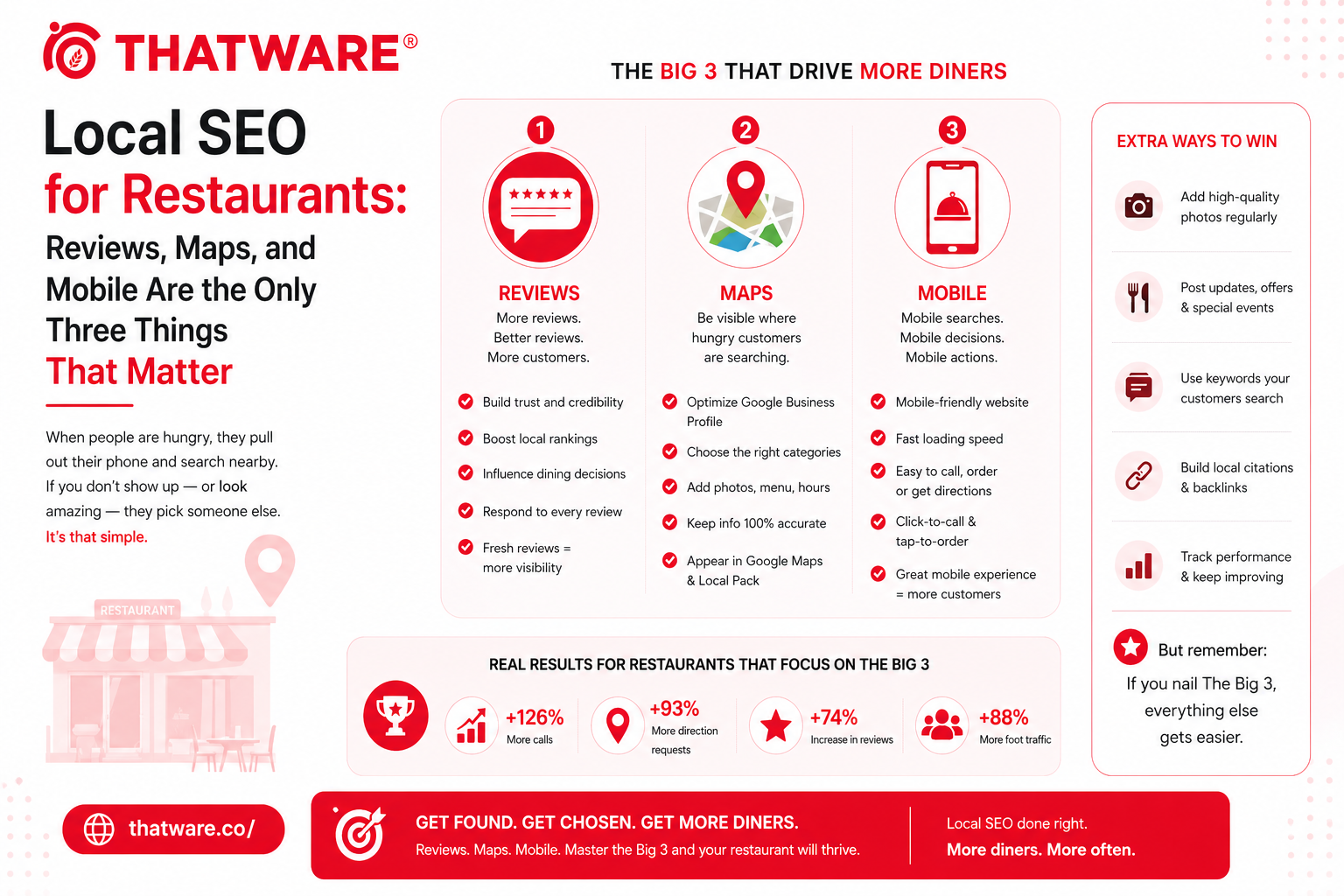
Restaurant owners get a lot of confusing SEO advice. Blog posts about content marketing, backlink strategies, technical audits. Most of it is correct in the abstract and largely irrelevant to the specific problem a restaurant has, which is appearing prominently when someone nearby is looking for food.
Local SEO for restaurants is genuinely narrower than general SEO. The ranking factors that matter most are specific, the competitive landscape is defined geographically, and the user behavior patterns are clear. Mobile intent, Maps-first search, review influence on both ranking and click decisions. Master these three things and you’ve addressed the majority of the organic discovery problem for most restaurants.
Let’s go through each one properly.
Reviews: They’re a Ranking Factor, Not Just a Reputation Signal
Restaurant owners often think of reviews as something that affects customer perception. They’re right, but reviews also directly affect local search ranking, specifically performance in the Google Maps local pack.
Google uses review quantity, review recency, average rating, and review velocity as ranking signals for local businesses. A restaurant with three hundred reviews, a 4.3 average, and fresh reviews from the past week is treated differently by the algorithm than one with forty reviews, a 4.1 average, and nothing recent.
The implication is that actively building reviews is an SEO strategy, not just a customer service initiative. The restaurants with the most reviews in a local pack consistently outrank competitors with comparable food and service quality but thinner review profiles.
Building reviews requires asking. Most satisfied customers don’t leave reviews spontaneously. Sending a follow-up text with a review link after a booking, asking verbally when handing over the bill, placing a QR code on the receipt that links to your Google review page. These systems, practiced consistently, produce compounding review velocity that improves both rank and conversion rate for searchers who check reviews before choosing.
Local seo services for restaurants spend significant attention on review strategy because the correlation between review strength and local pack placement is as clear as any ranking factor in local search.
Maps Optimization: Your Google Business Profile Is a Website
Most restaurant owners treat their Google Business Profile as a directory listing that exists and needs to be accurate. It’s more than that. It’s the primary interface between your restaurant and local searchers, and its optimization has direct ranking implications.
A fully optimized profile covers all the dimensions Google evaluates. Primary and secondary category selection that reflects what your restaurant actually is, not just the broadest category. Complete attribute selection covering things like outdoor seating, reservation options, accessibility features, payment methods, alcohol availability. Updated hours that reflect holiday and special schedules accurately. Photos that are recent, high-quality, and cover the interior, exterior, food, and team.
Post content on the profile, used by a minority of restaurants, signals ongoing active engagement and can drive visibility for specific searches around events, promotions, or seasonal menu changes.
The accuracy and completeness of this information affects how Google ranks your profile for relevant searches, not just how appealing it looks to users who find it.
Mobile: Everything Happens on a Phone
The majority of restaurant searches happen on mobile devices, typically within a few minutes of the searcher making a decision to eat. “Sushi near me” at 7pm on a Saturday is the search pattern. The user wants results fast, wants to see photos, wants to see reviews, and wants to be able to call or navigate with one tap.
Local business seo for restaurants needs to account for the mobile-first nature of this discovery behavior in several ways.
Your website needs to load fast on mobile. A restaurant website that takes four seconds to show the menu on a phone loses customers to competitors who load in one second. Core Web Vitals for mobile matter here in ways that affect both ranking and conversion.
Click-to-call and click-to-navigate functionality needs to be prominent and working. For a restaurant, the primary conversion from a mobile searcher is a phone call to make a reservation or a navigation action to get directions. Burying the phone number below the fold or making it non-tappable is a conversion problem and a user experience signal.
The menu needs to be accessible and readable on mobile. PDF menus that don’t render well on phones are both a user experience failure and a missed SEO opportunity. An HTML menu with actual text allows Google to understand what dishes you serve, which affects how you rank for specific dish searches.
What Doesn’t Matter as Much
For most restaurants, off-page link building beyond citation management is a lower priority than the three areas above. Getting consistent, accurate listings across Tripadvisor, Yelp, OpenTable, Zomato, and other relevant directories matters for citation signals and for being found on those platforms. An elaborate link acquisition program is rarely the highest ROI SEO investment for a restaurant.
Technical SEO beyond the basics, namely fast load times, mobile responsiveness, and clean indexing, is also not where most restaurants should be spending time. The local search ranking factors are dominated by profile optimization, reviews, and proximity, not the technical sophistication of the website.
The focus area for restaurant local SEO is narrow, which is actually good news. You don’t need to master an enormous discipline. You need to execute consistently on a clear set of activities that directly affect local pack placement and click rates from it.
Reviews, Maps, and mobile. Do these well and most of the local SEO problem is solved.